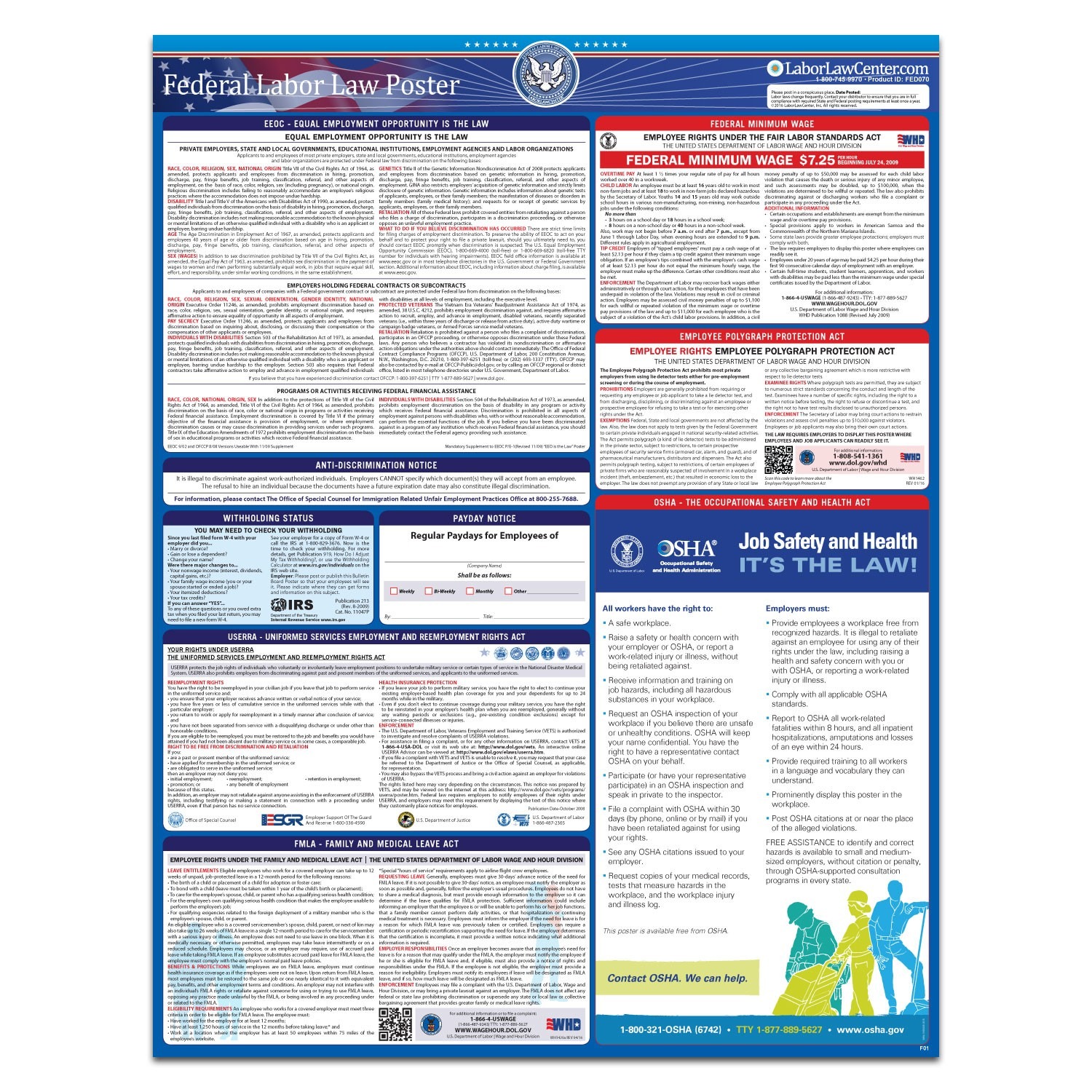
The Family and Medical Leave Act of 1993 (FMLA) guarantees workers unpaid job-protected leave in the event of their own or an immediate family member’s serious illness, or to care for a new child.
The U.S. Department of Labor published proposed changes to the FMLA rules on February 11, 2008.
There are three major changes. One involves employee notice obligations, another covers employer notice obligations, and the third expands FMLA leave to 26 weeks for some military families.
The military leave expansion, under the National Defense Authorization Act (NDAA) of 2008, went into effect January 28, 2008. The rest are due to take effect on April 11, 2008.
Assistant Secretary for the Employment Standards Administration Victoria A. Lipnic said the set of proposal “preserves workers’ family and medical leave rights while improving the administration of FMLA by fostering better communication in the workplace.” She also noted the expansion in military leave “to families of America’s soldiers who are suffering serious illness or injury.”
Under the new rules, North Carolina employees would have to follow company policy for notifying an employer then they plan to use FMLA leave. Employers have noted that under the old regulations workers had two businesses days after an absence in which to notify the company that the absence was in fact FMLA leave. The lack of notice was a serious disruption in operations.
Employees are also protected. The regulations help assure that workers will not be denied FMLA under a technicality. If an employee’s medical certification is lacking something or is incorrect, employers must notify the worker in writing. The employee then has seven days to correct the problem. All employer notice requirements are now consolidated, and the new rules are designed to assure that employees know their rights to FMLA leave. Employers also have five business days rather than two to send designation and eligibility notices to employees.
Some technical changes are also included in the proposal. They reflect Supreme Court and lower court decisions since the FMLA was passed.
More North Carolina FMLA Changes
Employers and others have until April 11, 2008 to comment on new proposed changes to the Family and Medical Leave Act (FMLA) rules, first published by the U.S. Labor Department on Feb. 11, 2008. The rules will go into effect around the April 11 date.
Post comments at http://www.regulations.gov under the keywords “Family and Medical Leave Act,” including the quotes as shown. All comments will be published in their complete form, including whatever contact information is provided.
The changes, according to the U.S. Department of Labor, should result in better communication with three key groups, employers, workers, and healthcare providers.
The FMLA rules are enforced by the Labor Department’s Wage and Hour Division.
One of the tentative changes strengthens a Labor Department stand that employees may settle FMLA claims out of court, but must waive their FMLA rights retroactively in order to do so. FMLA rights may still not be waived in advance, ruling out the possibility of a union contract denying entitlement to FMLA leave.
Another addresses the issue of “light duty,” stressing that it may not be counted toward an employee’s FMLA leave time. A worker may receive “light duty” worker for 10 weeks, for example, and still be entitled to the full 12 weeks or more of FMLA time. “Light duty” would not affect an employee’s FMLA reinstatement guarantee. In short, if a warehouse worker were given a “light duty” assignment in the parts department because of a back injury, she or he would be reinstated to the warehouse job after FMLA leave. The position reverses court case trends. Two lower courts have ruled that “light duty” time may be part of FMLA leave.
A third proposal takes into account a U.S. Supreme Court case known as Ragsdale vs. Wolverine World Wide, Inc. The Court ruled that under some conditions employees who have taken more than 12 weeks of paid leave may not have the right to the 12 weeks or more of unpaid FMLA leave. An employee was denied FMLA leave after 30 weeks of unpaid leave. The Labor Department took the matter to court.